ecourts NY offers New Yorkers a simple way to check court cases and manage filings online. The system allows users to perform NY eCourts case search in real time, giving instant access to civil, criminal, and family court information. Webcrim connects directly to the New York Unified Court System, ensuring accurate and up-to-date case details. Users can view filing dates, party names, and hearing schedules without visiting a courthouse. The platform also supports electronic document submissions, saving time and reducing paperwork. By providing these tools, ecourts NY makes court interactions faster and more convenient for everyone.
ecourts NY features a secure online judiciary portal where legal professionals and the public can monitor cases efficiently. Through Webcrim, users can track case progress, check court calendars, and receive notifications for updates. The portal supports eFiling, making document submissions straightforward and reliable. Search filters allow users to find cases by party, case type, or county. This integration keeps information organized and accessible. Overall, ecourts NY empowers individuals and attorneys with transparency and control over court processes.
What Is eCourts NY?
eCourts NY is the official digital platform of the New York Unified Court System that allows users to access court information quickly and efficiently. It functions as a state court database, providing real-time updates on cases, filings, and court schedules. The platform is designed to support both the public and legal professionals with secure and convenient digital case access.
At its core, eCourts NY centralizes multiple court services into a single online portal. Users can perform court document searches, track case statuses, and review hearing calendars without visiting a courthouse. The system updates continuously, ensuring that all case information reflects the most current filings and court actions. This real-time capability makes it easier to stay informed on civil, criminal, and family court matters across New York State.
Two key interfaces within eCourts NY are WebCrims and WebCivil:
- WebCrim – Focused on criminal case records, this tool allows users to check indictments, arrests, and criminal court appearances. It is widely used by attorneys, law enforcement, and individuals monitoring criminal proceedings.
- WebCivil – Designed for civil cases, including landlord-tenant, small claims, and commercial disputes. Users can access filings, motions, and court calendars related to civil litigation.
Access varies depending on the user type. Attorneys and authorized legal professionals can view detailed case records, eFile documents, and receive notifications for court updates. Meanwhile, the general public can use the system to perform basic court document searches, check case status, and see hearing dates, though some sensitive details may be restricted to protect privacy.
WebCrim vs WebCivil Supreme
WebCrim and WebCivil Supreme are two primary online portals within the New York Unified Court System, offering distinct functionalities for criminal and civil case information. Both platforms provide secure digital case access, but they serve different court types and user needs. Understanding their differences helps users efficiently perform criminal case lookup or civil case search across New York courts.
WebCrim – Criminal Case Lookup
WebCrim focuses on criminal proceedings in New York, providing real-time updates on cases in County Court NY, Criminal Court NY, and other criminal divisions. The platform allows:
- Case Tracking: Users can check indictments, arrests, court appearances, and dispositions.
- Party Information: Search by defendant or attorney to see involved parties.
- Court Calendar Access: View upcoming hearings and trial schedules.
WebCrim is particularly useful for attorneys, law enforcement, and individuals monitoring criminal cases. While the public can access basic case details, some sensitive information is restricted to protect privacy and comply with court regulations.
WebCivil Supreme – Civil Case Search
WebCivil Supreme is designed for civil litigation in the Supreme Court NY, County Court NY, and certain family matters handled in Family Court NY. The portal enables:
- Filing Records: Access to complaints, motions, judgments, and other civil filings.
- Case Status Updates: Real-time information about pending cases and hearing outcomes.
- Court Calendar Access: Check trial dates, conferences, and deadlines.
This system benefits attorneys managing multiple civil cases, as well as individuals involved in disputes or monitoring legal actions. The public can perform a civil case search, but detailed filings or sensitive data may require attorney credentials.
How to Use NY eCourts Case Search
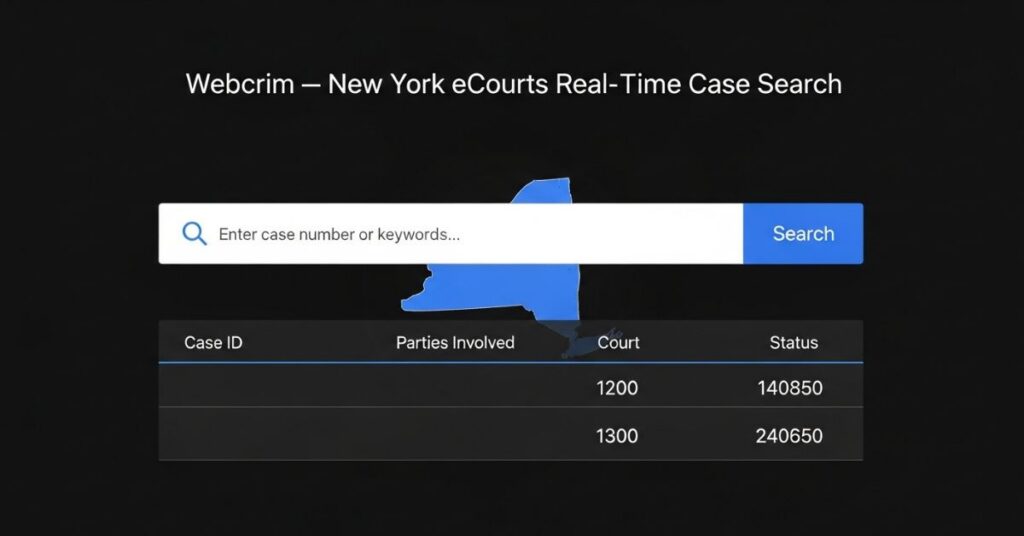
The NY eCourts case search system allows users to check case information, track court dates, and review filings online. By using this official portal, individuals and legal professionals can quickly access real-time case updates, including case status, hearing schedules, and court appearances. The official portal can be accessed here: https://iapps.courts.state.ny.us/webcivil/FCASMain.
The platform supports multiple search methods, including party name search, docket number search, and index number search. This flexibility ensures users can locate cases even with limited information. The following subsections explain each method and how to navigate the system efficiently.
Searching by Party Name
- Go to the official eCourts portal.
- Select the appropriate court type (e.g., Supreme Court, County Court, Family Court).
- Choose Party Name Search.
- Enter the first and last name of the individual or business involved in the case.
- Optional filters include county or case type to narrow results.
- Click Search to view matching cases.
Results display a list of cases with basic details, including parties involved, case status, and scheduled hearings. Users can click a case to access more detailed information, including recent filings and upcoming court appearance dates.
Searching by Docket or Index Number
For more precise searches, use the docket number search or index number search:
- Navigate to the portal and select the relevant court.
- Choose Docket/Index Number Search.
- Enter the docket number (for criminal cases) or index number (for civil cases).
- Click Search to retrieve the specific case record.
This method bypasses broad searches and immediately returns the correct case. The resulting page shows parties, filings, case type, and scheduled court events, ensuring users can track the case efficiently.
Viewing Case Status & Disposition
Once a case is located, the Case Status section provides:
- Current stage of the case (e.g., pending, disposed, adjourned).
- Recent filings or motions.
- Upcoming hearings and deadlines.
- Final disposition, including judgments or verdicts when available.
Monitoring the case status helps attorneys prepare for hearings, while the public can follow proceedings without visiting the courthouse. Notifications may be available for registered attorney accounts to stay updated automatically.
Case Details Page
The Case Details Page consolidates all relevant information in one place:
- Parties Involved – Plaintiffs, defendants, and attorneys.
- Case History – Chronological list of filings, motions, and rulings.
- Court Appearances – Upcoming dates, hearings, and conferences.
- Document Access – Links to public filings and court orders where permitted.
By reviewing this page carefully, users gain a complete picture of the case’s progress. For legal professionals, it provides actionable insights for preparation and document submissions.
eCourts Login NY – Attorney & Registered User Access
The eCourts login NY system provides secure access for attorneys and registered users to manage cases, submit documents, and monitor court activity online. Through the NYSCEF (New York State Courts Electronic Filing) platform, legal professionals can handle filings efficiently using the electronic filing system, also known as eFiling NY. Logging in allows authorized users to access confidential case records, file documents, and receive notifications directly from the courts.
Who Needs to Log In?
Primarily, the following users require attorney login credentials:
- Licensed attorneys representing clients in civil, criminal, or family court cases.
- Law firms managing multiple cases across counties.
- Court staff and authorized legal professionals monitoring filings and case updates.
Public users generally do not need an account unless specifically authorized to access restricted case information. Registered users can leverage the platform to submit filings electronically, track case progress, and access official court notifications.
How to Access NYSCEF
- Navigate to the official NYSCEF portal: https://iapps.courts.state.ny.us/nyscef/Login.
- Click Attorney Login or Registered User Login.
- Enter your assigned username and password.
- Complete any additional verification steps if prompted.
- Once logged in, users can submit documents, view filings, and monitor case status in real time.
The platform supports various document types, including motions, affidavits, and pleadings. Using eFiling NY streamlines the submission process, eliminates the need for paper filing, and ensures timely receipt by the court.
eFiling in New York – How NYSCEF Works
The NYSCEF platform is New York’s official electronic filing system, enabling attorneys to upload court documents efficiently for civil, criminal, and family cases. With eFiling NY, legal professionals can submit pleadings, motions, and other filings directly to the court, track deadlines, and receive notifications—all from a secure online portal.
Attorneys begin by logging into NYSCEF using their credentials. Once logged in, they select the relevant case and upload documents in the required formats, typically PDF. The system validates each submission to ensure compliance with court rules, including document size, naming conventions, and attachment requirements. Once successfully filed, the platform generates an electronic receipt and updates the Supreme Court eFiling record automatically.
What Court Records Are Available Online?
The ecourts court records system provides access to many public court records across New York, though some information remains restricted for privacy or security reasons. Users can perform a court document search for civil, criminal, and family cases via the state’s state court database.
Public vs Confidential Records
Public records typically include case summaries, filings, hearing dates, and judgments. Confidential or sealed records, however, remain inaccessible to protect privacy, especially in juvenile, domestic, or sensitive criminal cases.
Criminal vs Civil Access Rules
Criminal case records often have stricter access limitations, with details of arrests or indictments sometimes withheld from public view. Civil cases are generally more open, allowing access to motions, complaints, and court document searches, although some filings may still be restricted by court order.
Why Some Records Don’t Appear
Records may not appear due to court confidentiality, ongoing investigations, sealed case orders, or system updates. Users should also ensure they are searching in the correct court and jurisdiction, as state court database coverage varies across counties.
Courts Covered Under eCourts NY
The New York Unified Court System covers multiple court types, all accessible through eCourts NY. These include:
- Supreme Court NY – Handles civil cases, major torts, and complex litigation.
- Family Court NY – Manages custody, support, and domestic matters.
- County Court NY – Oversees criminal cases and certain civil disputes at the county level.
- Housing Court NYC – Focuses on landlord-tenant disputes within New York City.
Frequently Asked Questions
eCourts NY provides fast, reliable access to New York court cases, allowing users to check case status, view filings, and track hearing dates online. Both the public and legal professionals can search by party name, docket number, or index number.
Is WebCrim free?
Yes. WebCrim is a public service provided by the New York Unified Court System. Users can perform a criminal case lookup, view arraignment dates, charges, and dispositions without any fees. Access to attorney-level features requires registration.
How current is eCourts data?
The NY eCourts case search system updates in near real-time. Most filings, motions, and court actions are reflected immediately, though some court documents may take 24–48 hours to appear due to processing.
Can I remove my name from court records?
Generally, public court records cannot be removed. Sensitive cases may qualify for sealing or redaction through a court order. Requests require formal application and approval by the presiding judge.
How long do cases stay online?
Cases remain accessible through the state court database as long as they are active. Closed cases may stay online indefinitely unless sealed. Civil and criminal retention rules differ by court and case type.
How to seal a record?
To seal a record, you must petition the court with proper justification. The judge evaluates privacy concerns, case type, and legal criteria. If approved, the record is removed from public access, though it remains accessible to certain agencies.
Is NYSCEF mandatory?
NYSCEF (New York State Courts Electronic Filing) is required for most civil cases in participating courts, including Supreme Court NY and County Court NY. Attorneys must submit documents electronically unless a court grants an exemption.
Difference between WebCivil and NYSCEF?
- WebCivil Supreme: Provides case lookup, status updates, and public access to civil filings.
- NYSCEF / eFiling NY: Allows attorneys to submit documents electronically, track filings, and receive notifications. WebCivil focuses on information; NYSCEF focuses on submission.
Can I check my court appearance date online?
Yes. Both WebCrim and WebCivil Supreme list upcoming hearings. Registered attorneys can receive notifications, while public users can view scheduled dates via case search.